 Purple Orange AI

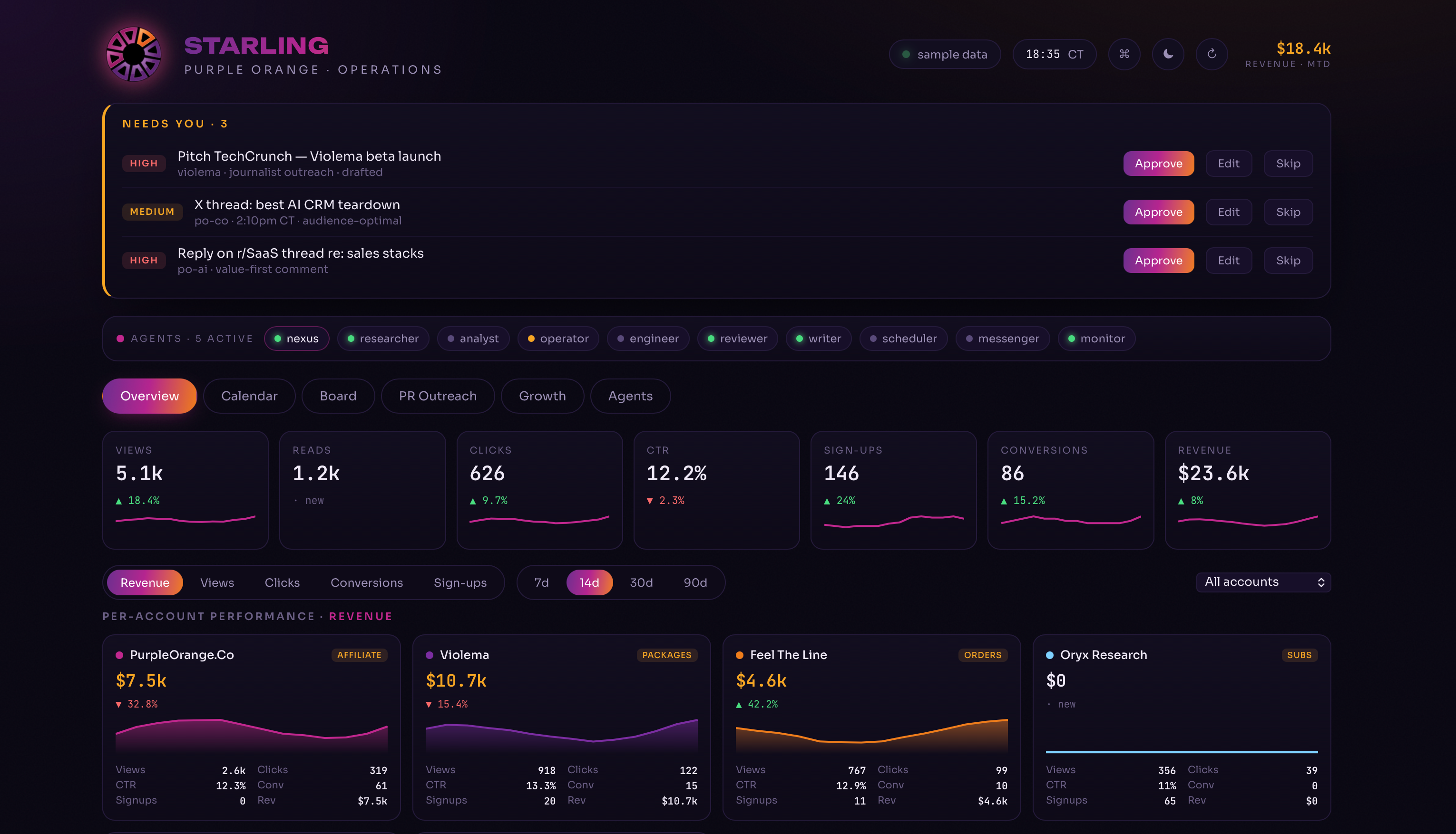
Short version: Starling is the Purple Orange Operations Engine: a single command surface for tracking content performance, social media, PR outreach, revenue, project-level distribution, and the human approvals that keep AI-assisted operations from drifting into chaos.
Most founder-led teams do not have a content problem in isolation. They have an operations problem.
The post went out, but no one knows whether it drove clicks. A PR pitch was drafted, but it is stuck in a doc. A thread did well, but no one turned it into a newsletter, short video, sales asset, or follow-up post. Revenue moved, but the team cannot connect it back to the content, campaign, or project that created the signal.
Starling is our answer to that gap. It is not a dashboard. It is a content creation and distribution machine with performance, revenue, PR, and approvals built into the same operating layer.
Why Starling exists
AI makes it easier to create more work. That is useful only if the system can decide what matters, move the right items forward, and show what happened after distribution.
For a team running several projects, the real bottleneck is not writing one more post. It is keeping the entire loop alive:
- Creation: ideas, drafts, campaign assets, posts, newsletters, replies, and PR pitches.
- Approval: what needs a founder, operator, editor, or client to approve before it ships.
- Distribution: where each asset goes, when it ships, and which account or channel owns it.
- Performance: views, reads, clicks, CTR, sign-ups, conversions, and revenue by project.
- Iteration: which signals should become the next post, pitch, landing page, offer, or campaign.
That loop is where Starling lives.
What Starling tracks in one place
Starling is designed around the way operators actually work: several projects, several audiences, several channels, and a constant need to decide what deserves attention now.
| Area | What Starling can organize | Why it matters |
|---|---|---|
| Social performance | Views, reads, clicks, CTR, audience fit, account-level trends, and post performance. | Teams can see which ideas actually earn attention before producing more noise. |
| Revenue | Revenue by project, sign-ups, conversions, affiliate signals, product orders, and campaign movement. | Content becomes connected to commercial outcomes, not just engagement metrics. |
| PR outreach | Journalist pitches, founder replies, launch outreach, draft status, and follow-up timing. | PR stops living in scattered docs, inboxes, and half-remembered conversations. |
| Content operations | Ideas, drafts, approval queues, publishing calendar, repurposing tasks, and distribution boards. | The team can turn one strong idea into a repeatable content system. |
| Project portfolio | Per-account performance across PurpleOrange.Co, Purple Orange Agent, Feel The Line, Oryx Research, and client projects. | Operators can compare which projects are creating traction and which need intervention. |
| Agents | Researcher, analyst, writer, reviewer, scheduler, messenger, monitor, and operator workflows. | AI agents become visible collaborators with review points, not invisible automation running loose. |
The goal is not to replace judgment. The goal is to make the whole operating picture visible enough that judgment can happen faster.
The real product is the distribution machine
Dashboards are useful, but dashboards alone are passive. Starling is built around the next action.
If a thread performs well, Starling should help turn it into a newsletter, a blog post, a sales asset, a press angle, or a follow-up campaign. If a product update is ready, Starling should help coordinate launch content, journalist outreach, founder replies, social posts, and performance reporting. If a client is running several offers, Starling should show which distribution paths are actually producing revenue.
Content only compounds when creation, distribution, performance, and revenue live in the same operating loop.
This is why Starling fits Purple Orange AI's broader work. We already build production AI workflows, custom integrations, MCP servers, agent systems, and approval paths. Starling is the opinionated operating layer for teams whose growth depends on shipping content and distribution consistently.
How clients will use Starling
We are preparing Starling for client workflows where visibility and execution need to live together.
- Founder-led content engines: turn founder ideas into posts, essays, newsletters, clips, replies, and weekly distribution plans.
- PR and launch operations: manage pitches, journalist lists, approvals, follow-ups, launch moments, and earned-media signals.
- Multi-project growth dashboards: compare social, content, sign-up, conversion, and revenue performance across several products or brands.
- Agency and client reporting: give operators one place to see what shipped, what needs approval, and what moved the numbers.
- AI-assisted distribution teams: make agent work visible, reviewable, and tied to measurable outcomes.
If your team already has a content operation but lacks a system for review, attribution, and distribution, Starling is the kind of layer that can turn scattered activity into operating leverage.
A practical deployment shape for Starling
The first useful version should be narrow. A team does not need every project, channel, and revenue source connected on day one.
- Choose one operating loop: social-to-newsletter, PR launch, founder content, client reporting, or revenue attribution.
- Connect the sources: social accounts, analytics, CRM, revenue data, content calendar, PR tracker, and docs where needed.
- Define approvals: decide which posts, replies, pitches, and campaign actions require human review.
- Track outcomes: measure views, clicks, sign-ups, conversions, revenue, shipped assets, and follow-up tasks.
- Expand the machine: only after the first loop works, add more projects, channels, agents, and reporting layers.
That sequence keeps Starling practical. It also gives clients a clear path from a workflow audit into a focused implementation sprint or broader operations buildout.
Find the first operating loop worth building.
Book the free Purple Orange AI workflow audit. We will map one content, PR, revenue, or distribution workflow, identify the tools and data involved, and tell you whether Starling, a sprint, or a custom operations buildout is the right next move.
FAQ
What is Starling?
Starling is the Purple Orange Operations Engine for content, PR, social performance, revenue tracking, distribution, approvals, and multi-project growth operations.
Is Starling just a dashboard?
No. The dashboard is the visible surface, but the product direction is an operating engine: approvals, agents, content tasks, distribution workflows, PR outreach, and performance loops in one place.
Who is Starling for?
Starling is built for founders, operators, agencies, and teams managing several products, brands, clients, or campaigns where content and distribution need to connect to revenue and action.
How should a team start with Starling?
Start with one operating loop: founder content, PR launch, social-to-newsletter, client reporting, or revenue attribution. Map the data, define approvals, measure outcomes, then expand.